

Have you ever read a formal email, legal document, job contract, or announcement and wondered about the “in lieu of” meaning? This common phrase may look complicated because it contains the unusual word “lieu,” but its basic meaning is actually simple: instead of or in place of. For example, “Employees received cash in lieu of vacation” means employees received money instead of taking vacation time.
In this complete guide, you will learn what “in lieu of” means, where it comes from, how to pronounce it, and how to use it correctly. We will also explore professional, academic, legal, medical, business, social-media, and everyday examples. By the end, you will know when “in lieu of” sounds natural and when a simpler alternative such as “instead of” is better.
Meaning & Definition of “In Lieu Of”

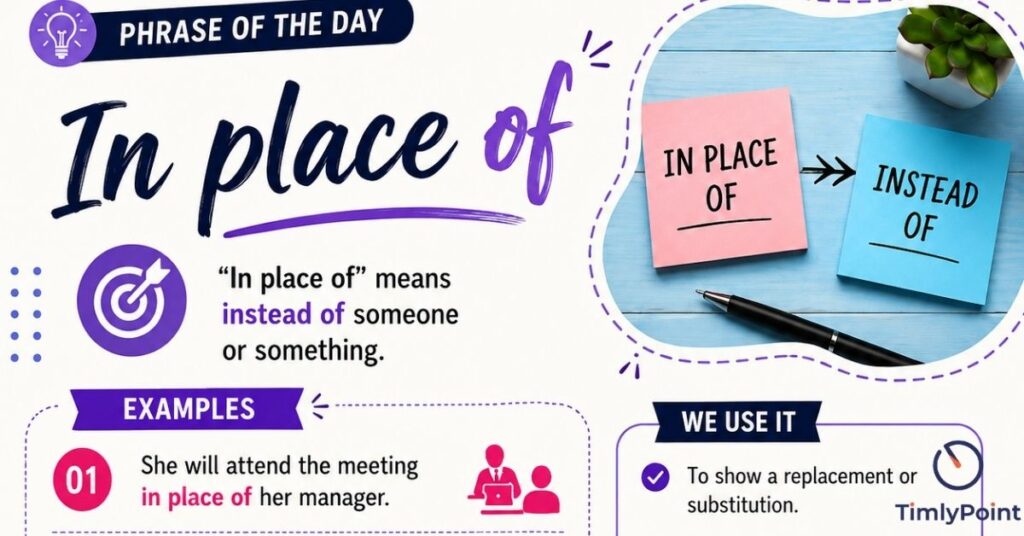
“In lieu of” means “instead of,” “in place of,” or “as a substitute for.” It is normally followed by a noun, noun phrase, or gerund.
Cambridge defines the expression simply as “instead of,” while Merriam-Webster gives the closely related meaning “in the place of.” Collins adds the useful idea that the replacement is often considered to have a similar value or importance.
Primary Meaning:
The primary meaning is instead of one thing, another thing is used, given, chosen, or accepted.
Examples:
- She took the bus in lieu of driving.
- The company offered cash in lieu of benefits.
- Please make a donation in lieu of flowers.
- He used his phone in lieu of a camera.
The phrase often suggests a deliberate substitution rather than simply mentioning two different things.
Secondary Meaning:
In some formal contexts, “in lieu of” can imply compensation, replacement, or an alternative arrangement.
For example:
The employee received payment in lieu of notice.
Here, the payment replaces the notice period or serves as compensation for it.
Other familiar expressions include cash in lieu, payment in lieu of notice, time off in lieu, and in lieu of taxes. Current dictionary examples show the expression continuing to appear in employment, financial, legal, and public-policy contexts.
Simple Explanation:
Think of it this way:
In lieu of X = instead of X
| Phrase | Simple Meaning |
|---|---|
| In lieu of coffee | Instead of coffee |
| In lieu of payment | Instead of payment |
| In lieu of flowers | Instead of flowers |
| In lieu of attending | Instead of attending |
| In lieu of vacation | Instead of vacation |
If you can replace “in lieu of” with “instead of” and the sentence still makes sense, you are probably using it correctly.
Background & Origin
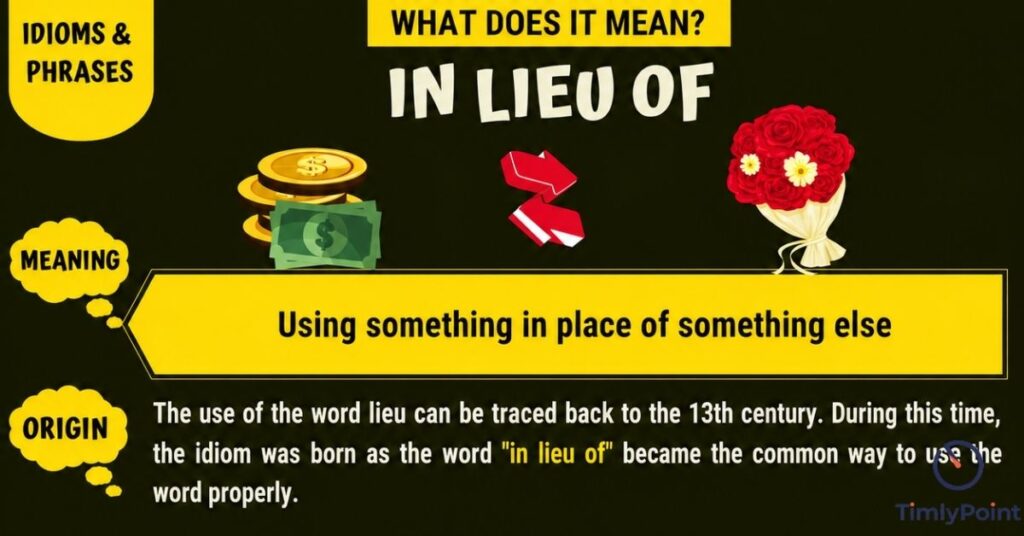
The word “lieu” comes from Old French and ultimately traces back through Anglo-French to the Latin word locus, meaning “place.” Merriam-Webster records the English noun “lieu” as an archaic word meaning “place” or “stead,” with its first known use dating to the 13th century.
The literal idea behind “in lieu of” is therefore close to “in the place of.” Over time, the phrase became established in English as a formal way to describe substitution.
Interestingly, “lieu” is rarely used by itself in modern everyday English. It is most commonly encountered inside the expression “in lieu of.”
Read More : Glaze Meaning Slang: What It Really Means, Origin, and How People Use It Online In 2k26
How to Pronounce “Lieu”
“Lieu” is pronounced approximately like “loo.”
So:
in lieu of → in LOO of
This pronunciation can surprise people because the spelling looks distinctly French.
Usage in Different Contexts
“In lieu of” is grammatically straightforward, but its tone changes depending on the setting. It is particularly common in formal, professional, legal, and written English.
1. Professional Context
At work, “in lieu of” frequently appears in policies, contracts, HR communications, and compensation discussions.
Examples:
- Employees may receive time off in lieu of overtime pay.
- The company offered a bonus in lieu of a salary increase.
- She received payment in lieu of notice.
- Staff can request cash in lieu of unused vacation days.
“Time off in lieu,” often shortened to TOIL, is especially common in workplace English, particularly in British usage.
2. Academic Writing
Academic writers may use “in lieu of” when describing one method, source, approach, or activity replacing another.
Examples:
- The researchers used digital surveys in lieu of paper questionnaires.
- Students submitted recorded presentations in lieu of live speeches.
- The study used interviews in lieu of written tests.
However, academic writing should prioritize clarity. If “instead of” sounds more natural, there is no need to use the more formal phrase.
3. Legal Context
Legal English uses “in lieu of” extensively because documents often need to describe substitutions, payments, obligations, and alternatives precisely.
Common expressions include:
- payment in lieu of notice
- damages in lieu of specific performance
- release in lieu of payment
- property transferred in lieu of money
- bail in lieu of a particular condition
Legal examples in current dictionaries and news usage demonstrate how widely the phrase appears in formal legal contexts.
Important: In a legal document, the exact meaning can depend on the surrounding contract or statute. “In lieu of” does not automatically mean two things are legally identical.
4. Everyday Formal Speech
You can use the phrase in ordinary conversation, but it can sound formal.
For example:
“I had tea in lieu of coffee.”
This is grammatically correct, but:
“I had tea instead of coffee.”
sounds more natural in casual conversation.
Use “in lieu of” when you want a formal, polished, or official tone.
Meanings Across Platforms (WhatsApp, Instagram, TikTok, Snapchat)
“In lieu of” does not have a special hidden meaning on WhatsApp, Instagram, TikTok, or Snapchat. Its basic English meaning remains instead of.
In WhatsApp messages, someone might write:
“I sent a voice note in lieu of calling.”
It means they sent a voice note instead of making a phone call.
Because WhatsApp conversations are usually informal, “instead of” will often sound more natural.
Instagram Captions
The phrase can work in captions when someone wants a sophisticated or playful tone.
Examples:
- “Coffee in lieu of sleep.”
- “Sunsets in lieu of small talk.”
- “Adventure in lieu of routine.”
These are stylistic uses rather than new definitions.
TikTok
On TikTok, “in lieu of” can appear in humorous captions or commentary:
“In lieu of productivity, I watched five hours of videos.”
The formal wording can itself create a joke because it contrasts with casual content.
Snapchat
A Snapchat message might say:
“Sending memes in lieu of an apology.”
Again, the phrase simply means instead of. There is no Snapchat-specific slang definition.
Other Fields of Use
1. Medical Field
Medical and healthcare writing may use “in lieu of” when one procedure, treatment, record, or communication method replaces another.
Examples include:
- telehealth consultation in lieu of an in-person visit
- electronic records in lieu of paper files
- one test in lieu of another test
However, medical decisions should never be based solely on the wording of a phrase. The exact clinical meaning depends on professional guidance and context.
2. Aviation
In aviation and travel-related writing, the phrase can describe an alternative arrangement.
Examples:
- A bus service was provided in lieu of the cancelled flight.
- Passengers received accommodation in lieu of immediate transportation.
- A digital document was accepted in lieu of a printed copy.
3. Technical / Engineering
Engineers and technical writers may use the phrase when explaining substitutions.
Examples:
- The team used aluminum in lieu of steel.
- A digital sensor was installed in lieu of the older mechanical component.
- The replacement system was tested in lieu of the original configuration.
Technical documents often favor precision, so “in lieu of” should be used only when the replacement relationship is clear.
4. Business & HR
Business English is one of the most common environments for this phrase.
Examples include:
- stock in lieu of cash compensation
- payment in lieu of notice
- time off in lieu of overtime
- benefits in lieu of salary
- cash in lieu of unused leave
Collins specifically lists examples involving payment, rent, tax, salary, and notice, showing the phrase’s strong connection with formal business and financial language.
Common Misconceptions & Mistakes
Mistake 1: Writing “in lue of” or “in loo of”
The correct spelling is:
in lieu of
Not “in lue of” or “in loo of.”
Merriam-Webster notes that the unusual spelling causes frequent misspellings.
Mistake 2: Thinking “lieu” means “law”
It does not. The word historically relates to place, not law.
Mistake 3: Assuming it always means “better than”
“In lieu of” simply indicates substitution. It does not automatically say that the replacement is better.
Mistake 4: Using it in every sentence
The phrase is formal. In casual conversation, instead of is usually clearer.
Mistake 5: Confusing “in lieu of” with “in addition to”
These phrases have opposite practical effects.
- In lieu of = instead of
- In addition to = as well as
Similar Terms & Alternatives
The easiest alternatives are:
- instead of
- in place of
- rather than
- as a substitute for
- as an alternative to
- replacing
Examples:
Formal:
“The company provided cash in lieu of benefits.”
Simple:
“The company provided cash instead of benefits.”
Alternative:
“The company provided cash in place of benefits.”
For everyday English, “instead of” is usually the safest choice.
How to Respond to It (Chat Examples)
If someone uses “in lieu of” in a message and you understand it, you can respond normally.
Example 1
Person A: “I sent the document by email in lieu of printing it.”
You: “That works for me.”
Example 2
Person A: “We are taking Friday off in lieu of working Saturday.”
You: “Sounds good.”
Example 3
Person A: “I brought tea in lieu of coffee.”
You: “Perfect, thank you!”
If you do not understand the phrase, you can simply ask:
“Do you mean instead of?”
That is a clear and natural clarification.
Differences From Similar Words
| Expression | Meaning | Tone | Example |
|---|---|---|---|
| In lieu of | Instead of | Formal | Cash in lieu of leave |
| Instead of | In place of | Neutral | Tea instead of coffee |
| In place of | As a replacement | Neutral/Formal | She attended in place of him |
| Rather than | Instead of/preference | Neutral | Walk rather than drive |
| As a substitute for | Replacement | Formal | Used as a substitute for sugar |
| In addition to | As well as | Neutral | Coffee in addition to tea |
The most important distinction is between “in lieu of” and “in addition to.” They should not be treated as interchangeable.
Relevance in Online Conversations & Dating Apps
On dating apps, “in lieu of” is uncommon but can be used creatively.
For example:
“In lieu of a boring first date, let’s visit a bookstore.”
Here, the writer means instead of having a boring first date, let’s do something different.
Other playful examples include:
- “In lieu of dinner, how about ice cream?”
- “In lieu of small talk, tell me your favorite movie.”
- “In lieu of texting forever, let’s meet for coffee.”
Because dating-app communication is generally casual, “instead of” may sound more relaxed. Using “in lieu of” can intentionally give a message a witty, polished, or slightly humorous personality.
Popularity & Trends Over Time
“In lieu of” is an old expression that remains active in modern English. It has not disappeared even though simpler alternatives such as “instead of” are much more common in casual speech.
Modern dictionary examples show the phrase continuing to appear in employment, finance, law, public policy, media, and everyday reporting. Dictionary.com, for example, currently displays 2026 examples involving holiday entitlement, compensation, legal custody, entertainment, and personal choices.
The phrase therefore has an interesting position in English: old-fashioned in flavor, but still useful and current.
Its strongest modern presence is in formal writing, especially:
- contracts
- HR documents
- legal language
- financial statements
- official notices
- workplace policies
- formal announcements
FAQs
What does “in lieu of” mean?
“In lieu of” means instead of or in place of something.
What is a simple synonym for “in lieu of”?
The simplest synonym is instead of. “In place of” is another close alternative.
How do you pronounce “in lieu of”?
“Lieu” is pronounced approximately like “loo,” so the phrase sounds like “in loo of.”
Is “in lieu of” formal English?
Yes. It is grammatically standard but generally more formal than “instead of.”
What does “payment in lieu of notice” mean?
It generally means a payment is made instead of requiring the person to work through a notice period, subject to the applicable employment rules or contract.
What does “cash in lieu” mean?
“Cash in lieu” means money provided instead of another benefit, item, or entitlement.
Can I use “in lieu of” in academic writing?
Yes. It is appropriate in academic writing when describing a replacement or alternative, although “instead of” may be clearer.
Is “in lieu of” the same as “rather than”?
They can overlap in meaning, but “rather than” can also emphasize preference or choice, while “in lieu of” strongly indicates substitution.
Is “in lieu of” correct for Instagram captions?
Yes. It can create a polished or humorous tone, although it is more formal than typical social-media language.
What is the difference between “in lieu of” and “in addition to”?
“In lieu of” means instead of, while “in addition to” means as well as. They express different relationships.
Conclusion
Understanding the in lieu of meaning is much easier once you remember one simple rule: “in lieu of” means “instead of” or “in place of.” It is a formal expression with a long history, and its roots connect the word “lieu” with the idea of a place or position. Today, it remains common in professional, legal, HR, academic, financial, and official English.
Although you can use it in everyday conversation and social-media captions, simpler alternatives such as “instead of” often sound more natural. When you see phrases such as payment in lieu of notice, cash in lieu, or time off in lieu, think about one thing being provided or accepted as a replacement for another. That simple idea unlocks nearly every common use of the expression.

Fred John is a passionate content writer and editor with 5 years of experience crafting engaging, SEO-friendly content. As an expert in puns and humor blogs, he specializes in creating original, witty, and reader-friendly articles that entertain audiences of all ages. Fred is dedicated to delivering high-quality, creative content that keeps readers laughing while providing value and an enjoyable reading experience.
