

If you have seen someone comment “stop glazing,” “bro is glazing,” or “you’re such a glazer,” you may have wondered what they actually mean. The glaze meaning slang has little to do with donuts, pottery, or shiny food coatings. In modern internet language, glaze usually means giving someone excessive praise, admiration, or support, especially when the praise seems exaggerated or unnecessary. The term is common in TikTok comments, gaming chats, sports debates, livestreams, and group conversations. In this guide, you’ll learn the meaning of glaze slang, where it came from, how people use it across different platforms, how it differs from similar words, and how to respond when someone calls you a “glazer.”
Meaning & Definition of Glaze (Slang)

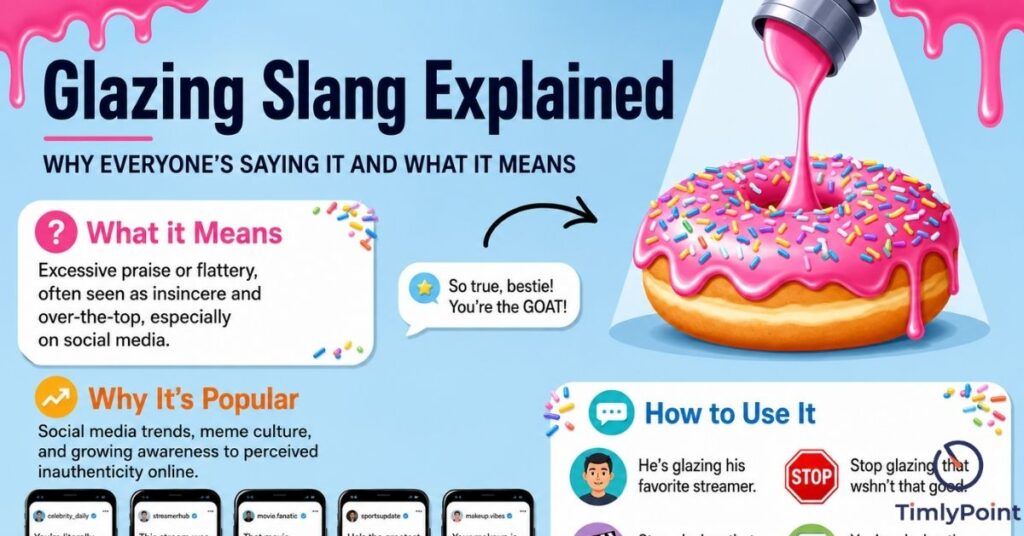
In modern internet slang, glaze means to praise, hype, admire, or defend someone excessively. It is usually used when the speaker believes the praise has gone too far.
For example:
- “Bro is glazing that player.”
- “Stop glazing him.”
- “The comments are full of glaze.”
- “I’m not glazing, he actually played well.”
The word can function as a verb or noun, while glazer refers to the person doing the excessive praising. Merriam-Webster defines the slang as showering someone or something with excessive praise and notes that it often carries a disapproving tone.
The important point is that glaze does not necessarily mean genuine admiration is wrong. It usually suggests that the admiration has become over-the-top, biased, repetitive, or embarrassing.
| Term | Meaning |
|---|---|
| Glaze | Excessive praise or hype |
| Glazing | The act of excessively praising |
| Glazer | Someone who does the glazing |
| Stop glazing | Stop overpraising someone |
| Glazing hard | Praising someone extremely excessively |
Caption-style examples:
“Bro gave one good performance and suddenly everyone is glazing.”
“Complimenting someone once isn’t glazing; doing it nonstop might be.”
“Stop glazing and let the facts speak.”
Background & Origin of the Term
The exact history of internet slang can be difficult to establish because slang often develops inside private chats, gaming communities, livestreams, and social-media posts before becoming widely documented.
Know Your Meme traces an early known online use of “glazing” to late 2021, while reporting that the term became increasingly visible on Twitch during 2022 through streamer culture. It later spread widely through TikTok, YouTube, X, gaming communities, and meme culture.
The metaphor appears to connect naturally with the traditional meaning of glaze: putting a shiny coating over something. Online, the idea became a humorous metaphor for coating someone in praise.
Dictionary.com similarly describes the modern slang as excessive praise and connects its spread with social platforms and livestream culture.
Today, the word is especially associated with Gen Z and Gen Alpha internet vocabulary. It is often used jokingly rather than as a serious accusation.
Usage in Different Contexts
1. Casual Chat
In casual conversations, “glaze” is usually playful.
If your friend says, “That’s the greatest movie ever made,” and keeps praising the movie for ten minutes, another friend might reply, “Bro, stop glazing.”
The expression can be friendly teasing rather than an actual insult.
2. Social Media
Social media is one of the biggest environments for glazing slang. Users may accuse someone of glazing a celebrity, athlete, musician, influencer, fictional character, or even a brand.
For example:
“You wrote five paragraphs defending him. That’s glazing.”
The term is particularly common in comment sections and reaction content, where users quickly judge whether another person is being too enthusiastic.
3. Gaming
Gaming communities frequently use glazing when a player repeatedly praises a professional gamer, streamer, character, weapon, or team.
Examples include:
- “You’re glazing that character too much.”
- “Bro won one round and you started glazing.”
- “The chat is glazing the streamer again.”
Gaming slang often relies on humor, exaggeration, and fast reactions, making “glaze” an easy shorthand.
Read More : Bite Into Fun: 240+ Hilarious Shark Puns That’ll Make Waves!
4. Dating Conversations
In dating conversations, the word can have a more personal tone.
If someone constantly compliments their crush, a friend might joke:
“You’re glazing them so hard.”
It does not necessarily mean the attraction is fake. It usually means the person appears too impressed, too complimentary, or overly focused on the other person.
Because dating conversations can be sensitive, the tone matters. A playful message between friends may be harmless, while saying it directly to someone you barely know could sound rude.
Meanings Across Platforms
The basic meaning remains similar across platforms, but the style changes.
| Platform | Typical Use |
|---|---|
| Friendly teasing in private chats | |
| Comments about celebrities, creators, looks, or achievements | |
| TikTok | Meme-style callouts and reaction comments |
| Snapchat | Casual jokes between friends |
| Twitch/YouTube | Live reactions to excessive praise |
On WhatsApp, “glaze” usually appears in group chats or conversations between friends.
Example:
Friend: “He is literally the best footballer ever.”
You: “Bro stop glazing 😂”
The private-chat setting generally makes the term more playful.
On Instagram, users may call someone a glazer when they repeatedly praise an influencer, athlete, celebrity, or creator.
Comments such as “the glazing is crazy” are often humorous reactions to enthusiastic fan behavior.
TikTok
TikTok has played a major role in popularizing and normalizing glazing slang. Users commonly write “stop glazing,” “bro is glazing,” or “glazing goes crazy” under videos and reaction clips. Know Your Meme documented the term’s growing TikTok presence as part of its wider internet spread.
Snapchat
On Snapchat, the term is generally used in direct messages or friend groups.
For example:
“You’ve sent me ten posts about her today. You’re glazing 😂.”
The meaning is still excessive admiration, but the context tends to be more personal and informal.
Other Fields (Non-Slang Meanings)
The slang definition should not be confused with the traditional English word glaze.
In cooking, glaze can mean a shiny coating placed on food, such as a donut, pastry, meat, or dessert.
In ceramics, glaze is a coating applied to pottery that can create a glass-like or decorative surface.
In art, glazing can describe applying transparent layers of color.
In construction, glazing can relate to glass installation, such as windows.
Merriam-Webster’s standard definition includes meanings involving glass, glossy coatings, food, ceramics, and smooth surfaces.
There is also the expression “eyes glazed over,” which describes someone appearing distracted, vacant, or mentally disconnected. This is a completely different use from modern internet slang.
Common Misconceptions & Mistakes
Common mistakes:
Mistake 1: Thinking glaze always means a compliment.
It usually implies that the complimenting has become excessive.
Mistake 2: Assuming it only applies to celebrities.
People can glaze friends, athletes, fictional characters, brands, streamers, or anyone else.
Mistake 3: Believing every compliment is glazing.
A sincere compliment is not automatically glaze.
Mistake 4: Confusing slang glaze with “glazed eyes.”
These expressions have different meanings.
Mistake 5: Assuming it is always an insult.
Among friends, it is often playful teasing.
Reality:
Context determines the meaning. The phrase “I’m glazing him” can be self-aware and humorous, while “stop glazing him” is usually a criticism of excessive praise.
The tone, relationship between speakers, and surrounding conversation all matter.
Similar Terms & Alternatives

Several words overlap with glaze, but they are not perfect substitutes.
- Overhype — praise or promote something too much.
- Fanboying/Fangirling — showing intense enthusiasm for someone or something.
- Simping — slang for showing excessive attention or devotion, often in a romantic context.
- Sucking up — trying too hard to gain someone’s approval.
- Brown-nosing — excessive flattery, usually for personal advantage.
- Dickriding — a much harsher slang expression for extreme support or admiration.
- Meatriding — another crude internet slang term for excessive praise or support.
“Glazing” is often chosen because it works as a humorous, meme-friendly way of calling out excessive admiration without always making the statement as serious or harsh as some alternatives.
How to Respond to “Glaze” in Chat
If someone calls you a glazer, your response depends on the situation.
Funny responses
- “I said what I said.”
- “Let me glaze in peace.”
- “Someone had to give credit.”
- “It’s not glazing if it’s true.”
- “I’m simply appreciating greatness.”
Calm responses
- “I’m not glazing; I genuinely like their work.”
- “You can disagree, but I actually mean it.”
- “I’m giving credit where it’s due.”
Playful comeback
“You call it glazing. I call it having good taste.”
A good response does not need to become an argument. Internet slang is often exaggerated for humor, so recognizing the tone can prevent unnecessary conflict.
Differences From Similar Words
| Word | Main Meaning | Typical Tone |
|---|---|---|
| Glaze | Excessive praise | Playful/critical |
| Compliment | Positive remark | Usually positive |
| Hype | Excitement or promotion | Positive/neutral |
| Fanboy | Very enthusiastic fan | Often teasing |
| Suck-up | Excessive praise for approval | Negative |
| Simp | Excessive devotion, often romantic | Teasing/negative |
| Overhype | Excessive promotion | Critical |
The biggest difference is that glaze specifically focuses on praise or admiration that appears excessive.
Someone can compliment you without glazing you. Someone can be a fan without glazing. The word becomes appropriate when the level of praise seems disproportionate.
Relevance in Online Conversations & Dating Apps
The glaze slang meaning has become relevant because online communication rewards short, memorable expressions.
A single phrase like “stop glazing” can communicate an entire idea: You are praising this person way too much.
On dating apps and dating-related chats, the expression can describe someone who appears excessively impressed by another person. For example, a friend might tease you for repeatedly saying how perfect your match looks.
However, slang should be used carefully in romantic conversations. Calling a new match a “glazer” may sound insulting or immature if you do not already share that style of humor.
The safest approach is to understand the relationship and tone before using slang.
Popularity & Trends Over Time
Glazing developed from niche internet language into a widely recognized slang term through social media, livestreaming, gaming, sports discussions, and meme culture.
Know Your Meme documents its emergence in online communities around 2021 and its increasing prominence on Twitch in 2022.
By the mid-2020s, major dictionary and reference websites were documenting the slang. Merriam-Webster describes it as excessive praise, while Dictionary.com notes its popularity among younger internet users and its use in phrases such as “stop glazing.”
In 2026, the word remains recognizable in online conversations, although slang naturally changes quickly. Its meaning is now broad enough to describe excessive admiration toward almost anything: a player, singer, creator, movie, character, friend, or brand.
The trend also shows how internet communities transform ordinary words into new social expressions. The traditional meaning of glaze remains unchanged, but online users have created an entirely separate metaphorical meaning around praise.
FAQs
What does glaze mean in slang?
Glaze means to praise, hype, or admire someone excessively, often in a way that seems exaggerated or unnecessary.
What does “stop glazing” mean?
“Stop glazing” means stop praising or defending someone so much. It is commonly used as a teasing or critical comment.
What is a glazer in slang?
A glazer is someone who excessively praises, supports, or hypes another person, celebrity, athlete, creator, or character.
What does glazing mean on TikTok?
On TikTok, glazing usually means overpraising someone, especially a creator, celebrity, athlete, or public figure. It is often used humorously in comments.
Is glazing a bad word?
It is slang and can sound rude or mocking, but it is not necessarily offensive in every context. Friends often use it playfully.
What does glaze mean in texting?
In texting, glaze generally means excessive praise or admiration. “Bro is glazing” means someone is praising another person too much.
What is the difference between glazing and complimenting?
A compliment can be sincere and reasonable, while glazing suggests that the praise has become excessive, exaggerated, or repetitive.
Why do people say “bro is glazing”?
“Bro is glazing” is a humorous way to call someone out for showing too much admiration or giving someone excessive praise.
Is glaze Gen Z slang?
Glaze is widely associated with Gen Z and Gen Alpha internet culture, especially on TikTok, Twitch, gaming communities, and social media.
Does glaze mean something different in cooking?
Yes. In cooking, glaze means a shiny coating applied to food. The slang meaning is unrelated to this literal culinary use.
Conclusion
The glaze meaning slang is simple once you understand the context: it generally means excessively praising, hyping, admiring, or defending someone. The term became popular through online communities, gaming, livestreams, TikTok, and meme culture, eventually becoming common internet vocabulary.
Remember that glaze is not the same as an ordinary compliment. The slang usually suggests that admiration has gone too far. It can be playful between friends, sarcastic in comments, or critical during online debates. At the same time, the traditional word still refers to coatings used in cooking, pottery, art, and glass-related contexts.
Once you recognize the tone and context, phrases like “stop glazing,” “bro is glazing,” and “he’s a glazer” become much easier to understand.

Fred John is a passionate content writer and editor with 5 years of experience crafting engaging, SEO-friendly content. As an expert in puns and humor blogs, he specializes in creating original, witty, and reader-friendly articles that entertain audiences of all ages. Fred is dedicated to delivering high-quality, creative content that keeps readers laughing while providing value and an enjoyable reading experience.