
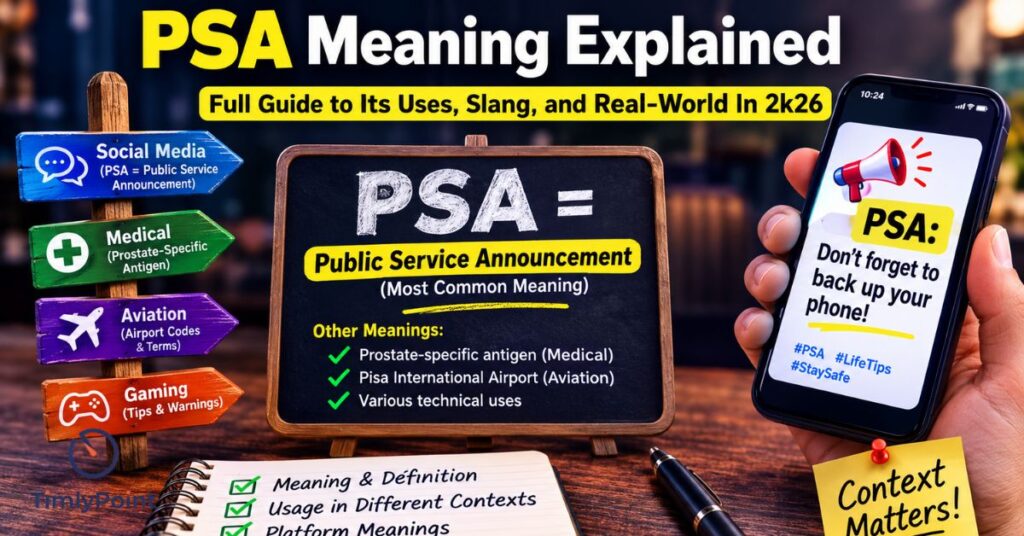
Ever seen “PSA:” at the beginning of a TikTok caption, WhatsApp message, or Instagram post and wondered what it means? The PSA meaning is usually “Public Service Announcement,” but the acronym has several meanings depending on the situation. Online, it has become a quick way to introduce useful information, a reminder, warning, opinion, or even a joke.
In this complete guide, you will learn what PSA means in text, social media, gaming, medical settings, aviation, and professional communication. We will also cover its origin, common mistakes, similar terms, popular platform uses, and simple ways to respond to PSA messages. Because context matters, understanding the sentence around the acronym is often the easiest way to identify the intended meaning.
Meaning & Definition of PSA
The most common PSA meaning is Public Service Announcement. Traditionally, a PSA is a message designed to inform or educate the public about an issue, often involving health, safety, community awareness, or responsible behavior.
In online communication, however, PSA is much more flexible. Someone may write “PSA: Check your email before Friday” simply to make sure everyone notices an important reminder. It does not necessarily mean the message comes from a government agency or official organization.
| Context | Common PSA meaning |
| Social media | Public Service Announcement |
| Texting | Important reminder or heads-up |
| Medical | Prostate-specific antigen |
| Aviation | Can refer to an airport code or industry-specific term |
| Gaming | Usually a public-service-style warning, tip, or announcement |
| Science | Several technical meanings depending on the field |
Merriam-Webster lists prostate-specific antigen and public service announcement among the principal meanings of PSA.
Public Service Announcement
A Public Service Announcement is communication intended to raise awareness or encourage the public to think about an issue or take a useful action. Traditional PSAs have appeared in radio, television, print, and later digital media.
Common subjects include:
- Road safety
- Public health
- Emergency preparedness
- Anti-smoking campaigns
- Drug awareness
- Environmental protection
- Community services
The modern online use keeps the same basic idea: “Pay attention—this information may be useful to you.”
Read More : Sigma Meaning Explained: Definition, Origin, Uses & Internet Culture Breakdown In 2k26
Examples:
- “PSA: Don’t forget to back up your phone.”
- “PSA: The store closes early today.”
- “PSA: Wear sunscreen when you spend the day outside.”
- “PSA: The game servers are down tonight.”
Medical Meaning
In medicine, PSA usually means prostate-specific antigen. It is a protein produced by the prostate gland and found in the blood. A PSA blood test measures its level. PSA can be elevated for several reasons, including prostate cancer, benign prostate enlargement, and inflammation or infection, so a PSA result by itself does not establish a cancer diagnosis.
This meaning is completely different from the social-media meaning. If you see PSA in a medical report, doctor’s discussion, or laboratory result, the medical context should take priority.
Aviation Meaning
Aviation has several uses for the letters PSA. One well-known example is PSA as the IATA airport code for Pisa International Airport in Italy. Its ICAO code is LIRP.
PSA can also appear in aviation-related organizational or technical terminology. Therefore, pilots, airport staff, travel agents, and aviation professionals should not automatically interpret PSA as “Public Service Announcement.”
The key lesson is simple: in aviation, always check the surrounding terminology.
Gaming / Internet Slang

In gaming and internet communities, PSA normally keeps the meaning Public Service Announcement, but the tone becomes casual.
A gamer might post:
“PSA: The new update resets your settings.”
Another player could write:
“PSA: Save your resources before the weekend event.”
Gaming PSAs commonly introduce tips, patch information, warnings, server updates, or community advice. Online users have also used PSA humorously to make an ordinary opinion sound unusually official.
Background & Origin of PSA
The idea behind public service announcements predates social media by many decades. Public-interest messages were distributed through newspapers, radio, film, and television to inform communities about important issues.
During the 1940s, public-interest broadcasting became especially visible in the United States around wartime communication. Messages encouraged public participation in national efforts and used short, memorable phrases designed to work within limited broadcast time.
Over the decades, PSA campaigns expanded into subjects such as road safety, health, smoking, substance abuse, children’s safety, and environmental awareness. Government agencies, nonprofit organizations, broadcasters, and community groups all used the format.
The internet changed the concept dramatically. A person no longer needed access to a television station or radio network to make an announcement. A short post, video, story, or comment could reach thousands or millions of people.
That evolution explains why PSA now works both as a formal communication term and as casual internet slang.
Usage in Different Contexts
The meaning of PSA is strongly connected to who is using it, where it appears, and what comes after it.
In formal communication, PSA can introduce serious public information. In casual communication, it may simply mean “here is something you should know.”
In Chats & Messaging Apps
In chats, PSA is usually an attention-grabbing abbreviation.
For example:
“PSA: Tomorrow’s meeting starts at 9.”
The writer is not necessarily making an official public announcement. They are simply highlighting information for the group.
People also use PSA for:
- Reminders
- Helpful tips
- Warnings
- Schedule changes
- Group notices
- Funny observations
On Social Media
Social media has made PSA especially popular because the format suits short-form content. A creator can begin a caption with “PSA:” and immediately tell followers that something noteworthy is coming.
Examples include:
- “PSA: Check the ingredients before buying.”
- “PSA: This shortcut saves so much time.”
- “PSA: Not every online review is genuine.”
- “PSA: Back up your photos.”
Modern social-media PSAs can be serious, educational, humorous, sarcastic, or promotional. The tone comes from the rest of the post.
Professional Use
PSA can also appear in workplaces, particularly in emails, team chats, community channels, and internal announcements.
For example:
“PSA: Please submit your timesheet by 5 p.m.”
That is understandable, but in a highly formal document, “Important Notice” or “Reminder” may sound more professional.
A good rule is to consider your audience before using internet-style abbreviations at work.
PSA Meanings Across Platforms
The core meaning usually stays the same across social platforms, but the tone can change.
On WhatsApp, PSA is particularly common in group chats. It can introduce a reminder that everyone in the group needs to see.
Example: “PSA: Dinner has been moved to 8 p.m.”
Instagram users often place PSA at the beginning of captions, Stories, or Reels. It can introduce advice, awareness content, opinions, or humorous observations.
Example: “PSA: You don’t need to follow every trend.”
TikTok
TikTok creators often use PSA to frame a short tip or warning before explaining something in a video.
Example: “PSA: Turn on two-factor authentication.”
Because TikTok content is fast-moving, PSA works as an immediate attention hook.
Snapchat
On Snapchat, PSA can appear in chats, Stories, or captions. The meaning is usually informal and conversational.
Example: “PSA: Bring a jacket tonight.”
Other Fields Where PSA Is Used
PSA is a highly ambiguous acronym. Acronym databases list hundreds of possible expansions across organizations, medicine, technology, science, business, and other categories.
Medical Field
The best-known medical use is prostate-specific antigen. Doctors may discuss PSA levels or a PSA test when evaluating prostate health.
Importantly, an elevated PSA level can have multiple causes. The National Cancer Institute notes that PSA can be higher with prostate cancer, benign prostatic hyperplasia, or prostate infection and inflammation.
Aviation
In aviation and travel, PSA can refer to Pisa International Airport, whose IATA code is PSA.
PSA can also occur in other aviation terminology, so the surrounding words are essential.
Science & Technical Use
Technical fields use PSA for several different concepts. Examples include pressure-sensitive adhesive, pressure swing adsorption, and polar surface area.
This is why technical documents should never be interpreted from an acronym alone. The subject area normally provides the answer.
Common Misconceptions & Mistakes
One common misconception is that PSA always means Public Service Announcement. It does not.
Another mistake is assuming that every online PSA is an official public announcement. On social media, people frequently use PSA informally.
Common mistake example:
Incorrect assumption:
“PSA means a government announcement.”
Better understanding:
“PSA traditionally means Public Service Announcement, but online it can simply introduce information that the writer thinks people should know.”
A second common mistake is confusing medical PSA with social-media PSA. If someone says, “My PSA level increased,” they are almost certainly discussing prostate-specific antigen, not a public announcement.
Similar Terms & Alternatives
Depending on context, alternatives to PSA include:
- Heads-up
- Reminder
- Notice
- Announcement
- Warning
- Alert
- Important update
- FYI
- Public notice
- Advisory
For casual texting, heads-up is often the closest natural alternative.
For professional communication, important update, notice, or reminder may be clearer.
How to Respond to PSA
You usually do not need a complicated response when someone sends a PSA. First, read what follows the acronym. Then respond according to the information provided.
If the message contains a reminder, acknowledge it. If it contains a warning, confirm that you understand. If it is funny, you can respond casually.
Examples:
PSA: The meeting starts at 10.
Response: “Got it, thanks!”
PSA: Don’t click that suspicious link.
Response: “Good catch. I’ll avoid it.”
PSA: This café has amazing breakfast.
Response: “Noted 😂 I’m going there this weekend.”
PSA: The server will be offline tonight.
Response: “Thanks for the heads-up.”
PSA vs Warning
A warning directly communicates danger or risk. PSA is broader.
A PSA can contain a warning, but it can also contain a reminder, tip, opinion, or general information.
Example:
“Warning: Road closed ahead.”
“PSA: Check the road conditions before leaving.”
The first is directly warning you. The second is presenting useful information.
PSA vs Announcement
An announcement simply communicates information, while a PSA traditionally has a public-interest purpose.
For example, “The store opens at 10” is an announcement. “PSA: The store opens at 10, so don’t arrive early” uses PSA as an attention-grabbing label.
Online, the distinction can become very small.
PSA vs Alert
An alert usually suggests urgency. PSA does not always imply urgency.
Alert: “Emergency evacuation notice.”
PSA: “PSA: Remember to renew your parking permit.”
Both attract attention, but their levels of urgency differ.
PSA in Online Conversations & Dating Apps
On dating apps and in DMs, PSA is generally used casually. Someone might write:
“PSA: Please read the profile before asking a question already answered there.”
Or:
“PSA: Coffee is always a better first-date idea than a three-hour dinner.”
In these settings, PSA can make a personal opinion sound playful or mock-official. It may also introduce a boundary, reminder, dating tip, or humorous observation.
Tone matters. A serious PSA may indicate that the writer genuinely wants people to pay attention, while a funny PSA may simply be a dramatic way of making a joke.
Popularity & Trends Over Time
PSA has survived because its original purpose fits modern internet communication surprisingly well. Traditional PSAs were short, direct, memorable, and designed to grab attention. Social media rewards many of those same qualities.
Search-focused pages published in 2026 commonly describe PSA as a digital shorthand for useful information, warnings, reminders, and attention-grabbing posts.
The acronym is therefore not really a brand-new slang word. Instead, its old meaning has been adapted to a new communication environment.
That is why “PSA” can sound serious in one context and completely playful in another.
FAQs
What does PSA mean in text?
PSA usually means Public Service Announcement in text messages and online chats. It often introduces important, useful, funny, or attention-grabbing information.
What does PSA mean on social media?
On social media, PSA commonly means Public Service Announcement but is often used casually to introduce advice, reminders, warnings, or opinions.
Is PSA considered internet slang?
PSA is technically an acronym rather than pure slang, but internet users commonly use it as casual online shorthand.
What does PSA mean medically?
In medicine, PSA means prostate-specific antigen, a protein made by the prostate that can be measured with a blood test.
What does PSA mean on TikTok?
On TikTok, PSA usually introduces a tip, warning, reminder, opinion, or piece of information that the creator wants viewers to notice.
What does PSA mean on WhatsApp?
On WhatsApp, PSA is commonly used before a group reminder or useful update, such as a schedule change or important notice.
What does PSA mean in gaming?
In gaming communities, PSA generally means Public Service Announcement and introduces tips, patch information, warnings, or updates relevant to players.
What does PSA mean in aviation?
In aviation-related contexts, PSA can have multiple meanings. It is also the IATA code for Pisa International Airport in Italy.
Is PSA the same as a warning?
Not exactly. A warning focuses on danger or risk, while PSA is broader and can introduce advice, reminders, information, or warnings.
How should I respond when someone says PSA?
Read the message after “PSA” and respond to its purpose. A simple “Thanks for the heads-up,” “Got it,” or an appropriate comment is usually enough.
Conclusion
The PSA meaning depends heavily on context, but Public Service Announcement remains its most familiar definition in everyday online communication. Traditional PSAs were created to inform the public about important issues, while social media has transformed the acronym into a flexible way to introduce reminders, tips, warnings, opinions, and jokes.
PSA can also mean prostate-specific antigen in medicine, while aviation and technical fields use the acronym in other specialized ways. The easiest way to understand PSA is therefore to look at the surrounding words and the setting. Whether you see it on WhatsApp, Instagram, TikTok, a gaming forum, or a medical document, context tells you which meaning is intended.

Fred John is a passionate content writer and editor with 5 years of experience crafting engaging, SEO-friendly content. As an expert in puns and humor blogs, he specializes in creating original, witty, and reader-friendly articles that entertain audiences of all ages. Fred is dedicated to delivering high-quality, creative content that keeps readers laughing while providing value and an enjoyable reading experience.

