

If you’ve spent any time on TikTok, Instagram Reels, Snapchat, or WhatsApp, you’ve almost certainly come across the term POV. From funny memes to cinematic videos, this three-letter abbreviation has become one of the most recognizable internet slang terms in recent years. But what does POV meaning actually stand for, and why is it everywhere online?
In simple terms, POV means Point of View. However, its meaning has expanded beyond literature and filmmaking into internet culture, where creators use it to place viewers inside a specific situation or perspective. In this guide, you’ll learn the definition, origin, social media usage, examples, platform-specific meanings, common mistakes, and how to respond when someone uses POV in chats—all updated for 2026.
POV Meaning & Definition
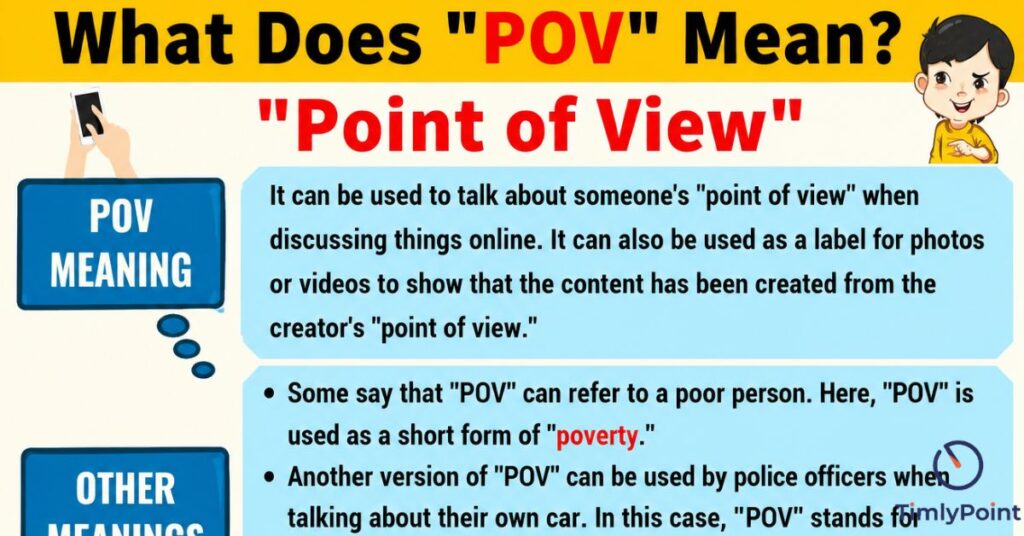
POV is an abbreviation for Point of View. It describes the perspective from which a story, image, conversation, or video is presented. While the phrase originally belonged to literature and filmmaking, social media has given it a fresh meaning that millions of users recognize instantly.
Primary Meaning:
The traditional meaning of POV is Point of View, referring to the position or perspective from which events are experienced or described.
Examples include:
- First-person point of view
- Third-person point of view
- Camera point of view
- Personal point of view
Secondary Meaning (Internet Use):
On social media, POV introduces a scenario where viewers imagine themselves in a particular situation.
Instead of simply describing an event, creators invite the audience to experience it from a chosen perspective.
Examples include:
- POV: You finally passed your driving test.
- POV: Your best friend surprises you on your birthday.
- POV: You’re meeting your online friend for the first time.
This format became especially popular through short-form videos on TikTok and Instagram.
Examples:
| Situation | Example |
| Chat | “From my POV, that’s the best option.” |
| TikTok | “POV: You’re the new student in class.” |
| Instagram Reel | “POV: You wake up on vacation.” |
| Gaming | “POV: You’re the last player alive.” |
Background & Origin of POV
Traditional Use:
The phrase Point of View has existed for centuries in storytelling.
Authors use POV to determine who narrates a story, including:
- First-person
- Second-person
- Third-person
Filmmakers also use POV shots to show exactly what a character sees.
Digital Evolution:
Around the late 2010s, TikTok creators transformed POV into a viral content style.
Instead of referring only to camera angles, people started using POV to introduce relatable, funny, dramatic, or emotional situations.
Soon, Instagram, Snapchat, YouTube Shorts, and Facebook adopted the trend, making POV one of the internet’s most recognizable content formats.
Usage in Different Contexts
POV now appears in many online and offline situations.
1. Social Media Content
This is where POV is most popular.
Creators use it to make viewers feel like they are inside the scene.
Examples:
- POV: You’re eating your favorite food after finals.
- POV: Your pet refuses to listen.
2. Chat Conversations
People also use POV while expressing personal opinions.
Examples:
- “My POV is different.”
- “From your POV, that makes sense.”
3. Storytelling & Memes
Memes frequently begin with “POV:” to create instant context.
Example:
POV: You remembered your homework five minutes before class.
The format immediately tells readers to imagine themselves in that scenario.
4. Gaming Community
Gamers often use POV when discussing gameplay or sharing first-person clips.
Examples include:
- POV gameplay
- POV sniper shot
- POV racing video
This usage closely matches the original meaning of seeing the action through the player’s eyes.
Meanings Across Platforms (WhatsApp, Instagram, TikTok, Snapchat)
Although POV always stands for Point of View, the way people use it varies slightly depending on the platform. Understanding these differences helps you interpret posts, captions, and conversations more accurately.
On WhatsApp, POV usually appears in personal chats or status updates. People use it to express their own perspective or create humorous situations that friends can relate to.
Examples:
- POV: You’re waiting for your friend who’s already 30 minutes late.
- From my POV, we should leave earlier next time.
- POV: Mom asks who finished the snacks.
Since WhatsApp is mainly used for private conversations, POV often reflects personal experiences rather than entertainment content.
Instagram creators use POV in Reels, Stories, and captions to make followers feel like they’re part of the moment. Lifestyle influencers, photographers, and travel creators frequently start their videos with “POV:” followed by a relatable situation.
Examples:
- POV: You’re watching the sunset on your dream vacation.
- POV: Your coffee arrives exactly when you need it.
- POV: It’s your first day at university.
This format helps increase engagement because viewers imagine themselves in the scenario.
TikTok
TikTok is where POV became one of the biggest internet trends. Thousands of creators upload short videos beginning with “POV:” to act out fictional, emotional, funny, or romantic situations.
Examples:
- POV: You’re the hero saving the world.
- POV: Your teacher catches you texting.
- POV: You accidentally become famous overnight.
TikTok’s creative storytelling style has made POV one of the platform’s most recognizable content formats.
Snapchat
On Snapchat, POV is commonly used in Stories, Spotlight videos, and captions to share daily experiences in a fun and engaging way.
Examples:
- POV: You’re running late for school.
- POV: Your best friend finally replies.
- POV: Weekend plans are canceled.
Because Snapchat focuses on quick visual updates, POV captions are usually short, humorous, and easy to understand.
Read More : PMO Meaning Full Guide to Definitions, Uses, and Online Contexts Explained In 2k26
Other Fields Where POV is Used
Although many people associate POV with internet slang, it has long been used in several professional and academic fields.
Film & Photography
In filmmaking, POV refers to a camera angle that shows exactly what a character sees. This technique helps viewers experience scenes through the character’s eyes, making movies feel more immersive.
Examples include:
- POV action scenes
- First-person camera shots
- Character perspective sequences
Psychology
In psychology, point of view refers to an individual’s personal perspective, beliefs, emotions, and interpretation of events. Understanding another person’s POV is important for empathy, communication, and conflict resolution.
Automotive & Aviation
In automotive testing and aviation, POV cameras are mounted on vehicles, helmets, or aircraft to capture real-time footage from the operator’s perspective. This type of recording is commonly used for training, demonstrations, and safety reviews.
Science & Technical Fields
Some technical industries use POV when discussing observational perspectives, simulations, virtual reality environments, or camera systems. Although the exact meaning varies, it generally refers to the viewpoint from which information is captured or displayed.
Common Misconceptions & Mistakes
Many people misunderstand how POV should be used online. While the term is simple, incorrect usage has become common across social media.
Common Mistakes:
- Thinking POV only belongs to TikTok.
- Using POV when describing someone else’s opinion.
- Adding “POV” without creating a specific perspective.
- Confusing POV with captions or hashtags.
- Assuming every first-person video is automatically a POV video.
Misconception:
A common misconception is that POV simply means “opinion.” While opinions can be expressed from a point of view, the internet slang usually places the audience inside a scenario rather than stating a personal belief.
✔ Correct Usage:
Correct examples include:
- POV: You’re boarding your first flight.
- POV: You finally finish your exams.
- POV: The waiter brings your favorite dessert.
Incorrect example:
- POV: Pizza tastes good.
This sentence expresses an opinion rather than creating a perspective for the audience.
Similar Terms & Alternatives
Depending on the situation, several phrases can be used instead of POV.
| Term | Meaning |
| Perspective | A person’s viewpoint |
| Viewpoint | Another word for point of view |
| Opinion | Personal belief |
| Angle | A particular way of looking at something |
| First-person | Narration from “I” perspective |
| Scenario | Imagined situation |
| Narrative | Storytelling approach |
Although these words are related, they do not always replace POV perfectly in social media content.
How to Respond to POV in Chats
When someone sends a message beginning with POV, they’re usually inviting you to imagine a situation or share your reaction.
You can respond naturally by joining the scenario, agreeing, or adding humor.
Examples:
Example 1
Friend: POV: You’re stuck in traffic before an interview.
Reply:
“That would definitely make me nervous!”
Example 2
Friend:
POV: You finally receive your dream job offer.
Reply:
“I’d celebrate all day!”
Example 3
Friend:
POV: Your favorite team wins the championship.
Reply:
“Best feeling ever!”
Example 4
Friend:
POV: You forgot your homework again.
Reply:
“That sounds way too relatable.”
Example 5
Friend:
POV: You wake up five minutes before class starts.
Reply:
“Instant panic mode!”
Responding this way keeps the conversation fun, engaging, and in line with the intended perspective.
Differences From Similar Words
Although POV (Point of View) is often confused with terms like opinion, story, and caption, each has a distinct meaning. Understanding these differences helps you use the term correctly in conversations, social media posts, and content creation.
| Term | Meaning | Example |
| POV | A specific perspective or scenario experienced by the audience | POV: You’re walking into your dream job interview. |
| Opinion | A personal belief or judgment | I think this movie is amazing. |
| Story | A sequence of events told in order | She shared a story about her vacation. |
| Caption | Text added to describe or complement a photo or video | Summer memories 🌞 |
POV vs Opinion:
A POV places the audience inside a situation or perspective, while an opinion simply expresses what someone thinks.
Example:
- POV: You’re trying spicy food for the first time.
- Opinion: I think spicy food tastes great.
POV vs Story:
A story usually has a beginning, middle, and end. A POV often focuses on a single moment or perspective without explaining everything that happens.
Example:
- Story: A detailed account of someone’s first day at college.
- POV: You’re walking into your first college class.
POV vs Caption:
A caption describes or complements content, while a POV creates an experience for the viewer.
Caption:
Weekend vibes with friends.
POV:
POV: You’re spending the perfect weekend with your best friends.
Relevance in Online Conversations & Dating Apps
The popularity of POV has expanded beyond entertainment and memes. Today, people use it in chats, dating apps, and online communities to make conversations more engaging and relatable.
Why it’s used:
People use POV because it:
- Makes conversations feel more interactive.
- Encourages viewers to imagine themselves in a scenario.
- Adds humor and creativity.
- Increases engagement on social media.
- Helps creators tell short stories quickly.
- Makes dating profiles and messages more interesting.
On dating apps, users often use POV to describe fun or romantic situations that encourage responses.
Examples:
- POV: We’re having coffee on our first date.
- POV: You finally found someone who replies instantly.
- POV: We matched after both swiping right.
- POV: You’re planning our weekend trip.
- POV: You laugh at all my terrible jokes.
These examples create a playful atmosphere and make conversations feel more personal.
Popularity & Trends Over Time
The meaning of POV has remained consistent, but its online usage has grown rapidly over the last decade. What started as a storytelling and filmmaking term is now one of the internet’s most recognizable content formats.
Trend Timeline:
| Year | Trend |
| Before 2000 | Used mainly in literature, journalism, and filmmaking. |
| 2010–2017 | Began appearing in online forums and YouTube videos. |
| 2018–2020 | Became a major TikTok trend with role-play and storytelling videos. |
| 2021–2024 | Expanded to Instagram Reels, Snapchat Spotlight, Facebook, and YouTube Shorts. |
| 2025–2026 | Continues to dominate short-form video content, memes, marketing, and influencer campaigns. |
Why it stays popular:
POV remains popular because it:
- Is easy to understand.
- Works across every major social platform.
- Encourages audience participation.
- Fits short-form video trends.
- Creates emotional and relatable content.
- Can be funny, educational, dramatic, or inspirational.
- Appeals to both creators and viewers.
As social media continues to evolve, POV is expected to remain one of the most effective storytelling formats in 2026 and beyond.
FAQs
What does POV mean in texting?
POV stands for Point of View. In texting, it’s used to present a situation from a specific perspective or to express someone’s viewpoint.
What does POV mean on TikTok?
On TikTok, POV introduces a scenario where viewers imagine themselves as part of the video or story.
Is POV an internet slang term?
Yes. Although Point of View has existed for centuries, POV has become a widely recognized internet slang term through social media.
Does POV always mean Point of View?
Most of the time, yes. However, in specialized industries such as film or photography, it may refer to camera perspective or shooting style.
How do you use POV correctly?
Use POV before describing a situation that places the audience inside a specific experience or perspective.
What does POV mean on Instagram?
On Instagram, POV is commonly used in Reels, Stories, and captions to create immersive and relatable content.
Can POV be used in WhatsApp chats?
Yes. People often use POV in WhatsApp messages to share opinions, jokes, or imagined scenarios with friends.
Is POV the same as an opinion?
No. An opinion expresses a belief, while POV describes the perspective from which a situation is experienced.
Why is POV so popular on social media?
POV encourages engagement, sparks imagination, and helps creators tell stories quickly through short-form videos.
Will POV still be popular in 2026?
Yes. POV continues to be one of the most popular storytelling formats across TikTok, Instagram, Snapchat, YouTube Shorts, and other social platforms.
Conclusion
Understanding the POV meaning is essential for navigating today’s digital conversations. While POV traditionally stands for Point of View, its role has expanded far beyond books and films. It has become a powerful storytelling technique used across TikTok, Instagram, Snapchat, WhatsApp, gaming communities, and even dating apps.
Whether you’re creating content, chatting with friends, or trying to understand the latest internet slang, knowing how to use POV correctly can make your communication more engaging and relatable. As short-form content continues to dominate social media in 2026, POV remains one of the most influential and widely used expressions online, making it a valuable term for both creators and everyday users.

Fred John is a passionate content writer and editor with 5 years of experience crafting engaging, SEO-friendly content. As an expert in puns and humor blogs, he specializes in creating original, witty, and reader-friendly articles that entertain audiences of all ages. Fred is dedicated to delivering high-quality, creative content that keeps readers laughing while providing value and an enjoyable reading experience.